Decades of articles, footage, images, and audio sit across separate archives and asset systems, tagged inconsistently or not at all. LangOptima ingests the content and metadata you already hold and connects it into a single queryable knowledge base, so teams find what they own in seconds, each result cited back to its source, instead of re-creating or re-licensing what already exists.
The approach the BBC pioneered with Dynamic Semantic Publishing: from the 2010 World Cup onward, more than 800 pages assembled automatically from one connected content graph, with journalists editing by exception. Thomson Reuters, now the London Stock Exchange Group, went on to ship a customer-facing graph of over two billion relationships.
A producer looks for everything the organization holds on a topic and starts from scratch each time. In many media teams, the fastest route to an asset is still asking whoever has been there longest.
Content lives across separate asset and archive systems, tagged inconsistently or not at all. Search runs on filenames and free text, not meaning, so teams re-create or re-license material the organization already owns.
Who owns what, for which territories, on which platforms, until when, is spread across contracts and spreadsheets. A simple availability question becomes a manual research task, and a clearance mistake is expensive.
Every story, asset, and contributor connects to others, but those connections stay in people's heads. When someone moves on, the map of what relates to what goes with them.
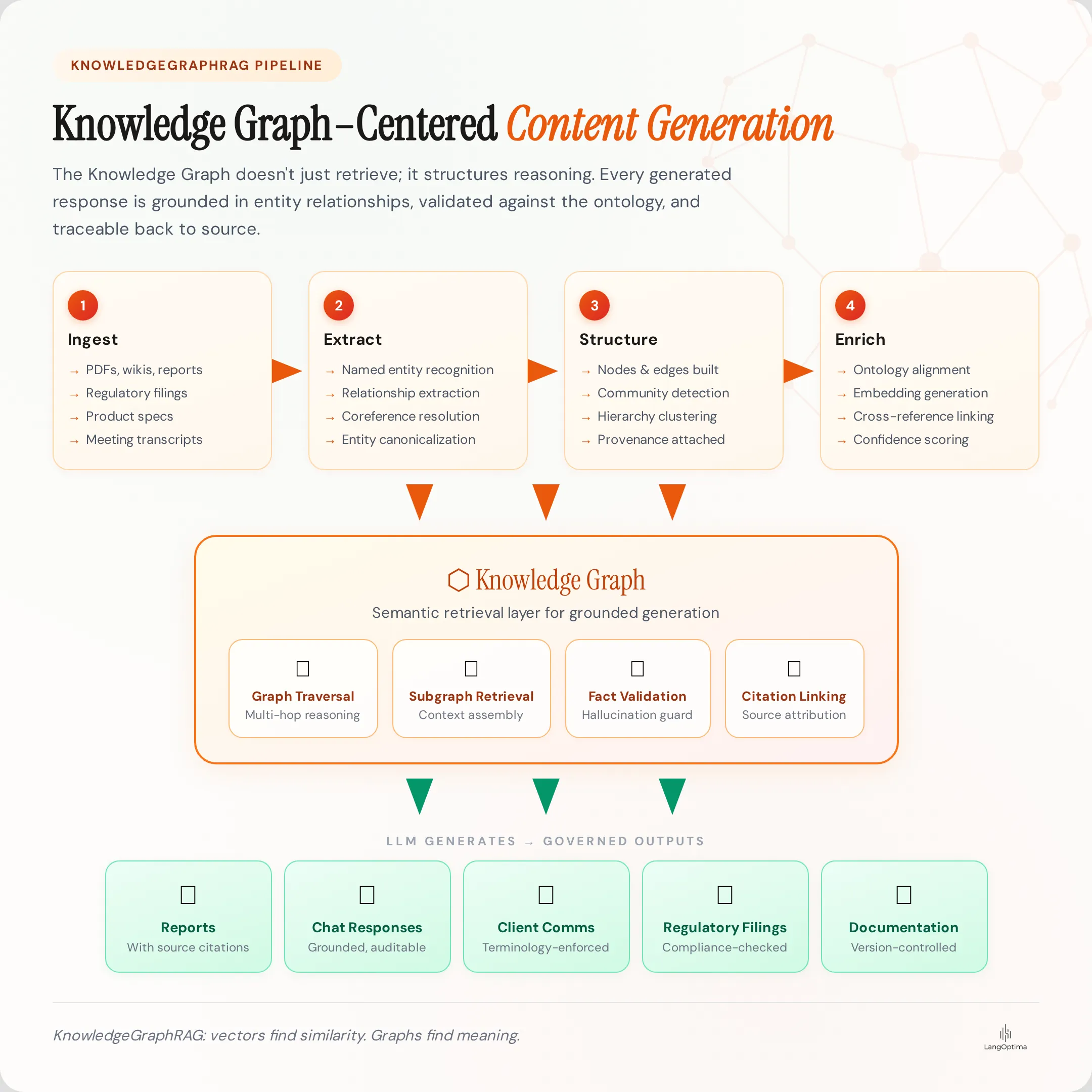
LangOptima ingests the content and metadata your organization already holds, including archives, asset systems, contracts, and catalog records, and structures what is inside them: titles, people, events, rights, territories, and the relationships between them. It resolves the duplicate and variant records of the same person, title, or event into single entities, and sits above your existing asset and rights systems without replacing them, so a question that once meant a manual search becomes a single query with the source attached.
Modern AI can structure a great deal on its own. Where it stops is the meaning specific to your organization: the concepts, rules, and relationships that make your business yours, and where its real value lives. Galaxia, the symbolic engine built by our partner Smabbler, computes that layer straight from your own data: no language model in the loop, and every connection traceable to its source. The graph reflects how you operate, not a generic template.
You don't have to boil the ocean. Start with a single business context and prove it there. Once that foundation is laid properly, the same connected data tends to open opportunities in other departments, so the next team builds on the work already done rather than starting from zero.
Archives, asset systems, rights records, and catalog metadata unified at the semantic layer. Nothing moves. Nothing is replaced.
Traverse from an event to every asset that covers it, from a contributor to every title they worked on, from a right to the territory and window it applies to. Connections no filename search will surface.
“What do we hold on this, and can we use it?” answered in seconds, with the source to back it. For archive, editorial, and rights teams alike.
Every producer and rights manager works with the organization's full catalog memory behind them, and new hires query decades of content from day one instead of learning it title by title.
Representative scenarios of how media teams apply a knowledge graph over their content and rights. Illustrative of the pattern, not published client references.
A broadcaster connects its archives, asset systems, and metadata in a knowledge graph. Producers search by meaning rather than filename, and footage the organization already holds surfaces directly, each result citing the system it lives in, instead of being re-shot or re-licensed.
A distribution team is asked whether a title can run in a given territory after a certain date. With rights modeled as connected data, titles, territories, windows, and expiry, the answer comes back as one query, traceable to the exact contract clause, instead of a manual read through PDFs.
However complex the data landscape underneath, the engagement itself stays simple.
We ingest the content and data you already hold, straight from the systems you already run. Nothing is replaced. Your teams keep working where they work today.
Galaxia computes a first structure over your real data in hours or days, so you can put questions to it before committing to anything. A scoped 8 to 12 week paid pilot then builds your first decision context against success criteria you set. Your domain experts contribute the knowledge, we do the engineering. If it proves value, you expand from there. If it doesn’t, it doesn’t scale.
You query the connected layer in plain language, and answers come in seconds, accurate and traceable, with citations back to the source so you can check them yourself.
Curious what disconnected data may be costing your organization? The free Data Silo Cost Calculator puts a number on it in about two minutes, with no signup to see the result.
Try the Data Silo Cost Calculator →For a single document with a single answer, plain search or an LLM pointed at your PDFs does the job well, and a knowledge graph would be overkill. The difference shows up on the questions one document can’t answer: whether you already own footage, an image, or an article on a subject, and whether the rights let you use it here, across archives, asset systems, and rights records that were never connected. Those answers live in the relationships across those systems and the contracts and metadata behind them, not inside any one of them. A knowledge graph connects them into one model, follows the chain across them, and returns each answer with a citation back to the source it came from. Something you can act on, and trust.
A 30-minute conversation about your content landscape: which systems hold your archives, assets, and rights, and what a connected view of them would answer first. No deck, no pitch.
The same connected-data approach, applied across sectors. Explore another industry.